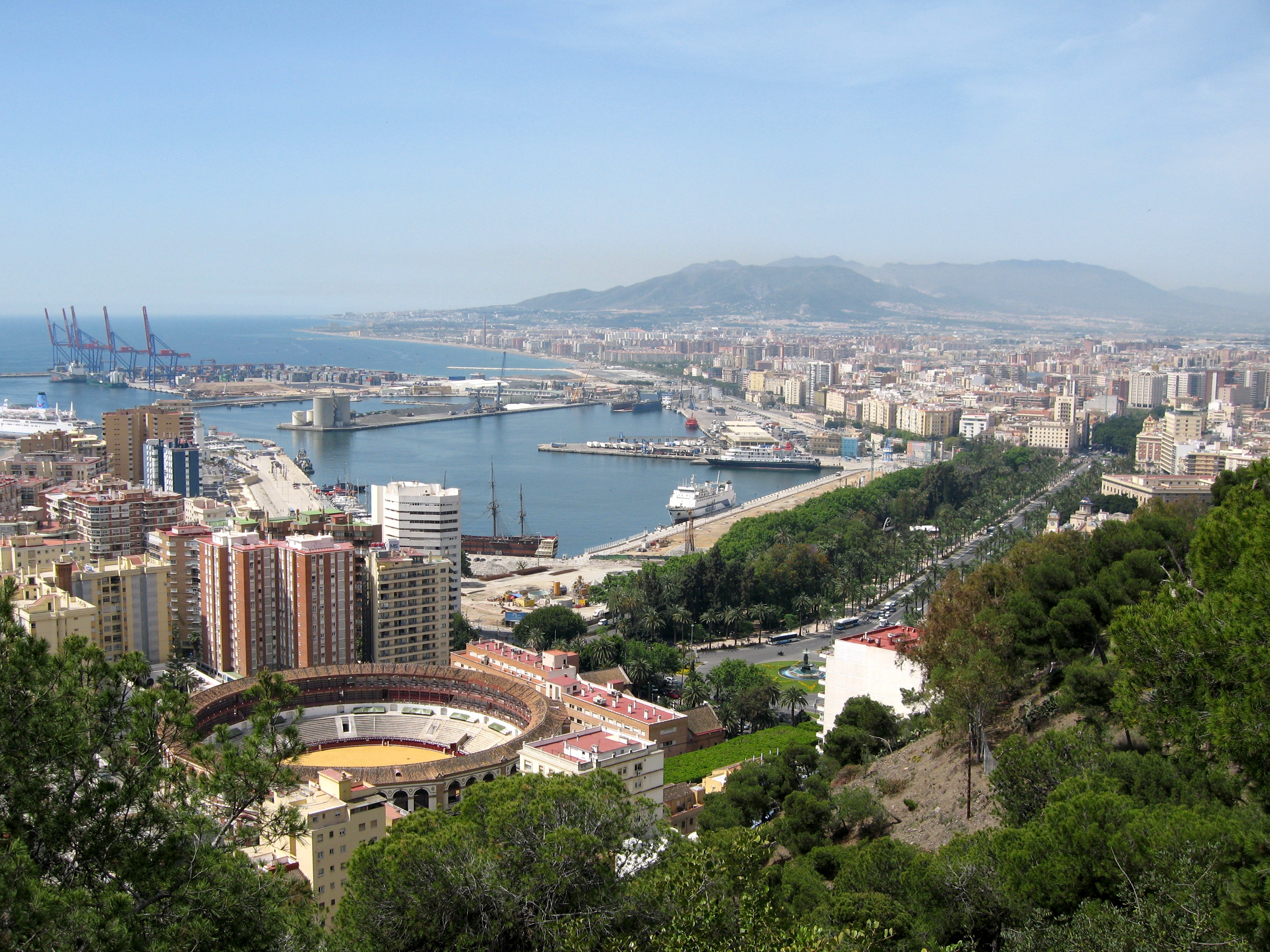
 The View Of Malaga From Gibralfaro Castle  |
Castle Of Gibralfaro
The Moors left the dominating castle on mount Gibralfaro that is connected to the Alcazaba, the lower fortress and regal residence. Both constructions built during the Taifas period (11th century) and extended during the Nasrid period (13th and 14th centuries.). The Alcazaba stands on a hill within the city of Málaga. Originally, the Alcazaba defended the city from the incursions of pirates. Later, in the mid-11th century, it was completely rebuilt by the Hammudid dynasty. Occupying the eastern hillside that rises from the sea and overlooks the city, the Alcazaba was surrounded by palms and pine trees.
Like many of the military fortifications that were constructed in Islamic Spain, the Alcazaba of Málaga featured a quadrangular plan. It was protected by an outer and inner wall, both supported by rectangular towers, between which a covered walkway led up the slope to the Gibralfaro. (This was the only exchange between the two sites.) Due to its rough and awkward hillside topography, corridors throughout the site provided a means of communications for administrative and defensive operations, also affording privacy to the palatial residential quarters. The entrance of the complex featured a grand tower that led into a sophisticated double bent entrance. After passing through several gates, open yards with beautiful gardens of pine and eucalyptus trees, and the inner wall through the Puerta de Granada, are the 11th and 14th century governor's palace.
It was organized around a central rectangular courtyard with a triple-arched gateway and some of the rooms have been preserved to this day. An open 11th century mirador (belvedere), to the south of this area, affords views of the gardens and sea below. Measuring 2.5 square meters, this small structure highlighted scalloped, five-lobed arches. To the north of this area were a waterwheel and Cyclopean well, (penetrating forty meters below ground) a hammam, workshops and the monumental Puerta de la Torre del Homenaje, the northernmost point of the inner walls. Directly beyond was the passage to the Gibralfaro above.


No comments:
Post a Comment